
Primary question: Does your workflow require complex multi-agent coordination beyond single-turn completions?
RepoDaily adoption score
RepoDaily rates this as 88/100 (strong) for adoption: evidence, installation path, production risk, differentiation, license clarity, and AI/agent fit are scored from the article sources and adoption notes.
4 source(s) across 3 source category/categories, plus a RepoDaily-specific evidence module when available.
5 workflow step(s), 4 next-action step(s), and 1 command/install signal(s) were detected.
Trending momentum is +134 stars, with maintenance/release/issue signals counted when present.
Risk is marked medium, with 5 security note(s) and 4 explicit skip condition(s).
2 opportunity lens item(s), 4 alternative(s), and 3 type-specific section(s) support differentiation.
License source or license wording is present.
10 AI/agent-related signal(s) were detected in the article text and metadata.
Project overview
RuFlo is an 'agent meta-harness' designed to extend Claude Code and Codex capabilities. It transforms the AI model into an orchestrator for complex workflows rather than a simple code generator. The framework provides a marketplace of plugins that introduce skills, slash commands, specialized agents, and MCP (Model Context Protocol) servers into the Claude environment.
Built in TypeScript, RuFlo allows developers to deploy intelligent swarms and coordinate autonomous workflows. It abstracts the complexities of multi-agent systems, providing tools for memory management (via RuVector), job scheduling, and goal-oriented action planning. The project aims to create a continuous software engineering environment where agents can perform security audits, generate tests, and manage documentation autonomously.
Recent updates in version 3.34.0 focus on runtime integration and security enforcement. The introduction of the AGNTCY/Outshift runtime, though optional, adds layers of authorization and observability using signed decision receipts. This indicates a maturation of the project from a set of scripts to a robust infrastructure for agentic systems.
Why it is trending now
- Surge in interest for agentic workflows and multi-agent systems within the AI development community.
- Integration with Claude Code's native `/loop` and `Monitor` tools provides immediate utility for users already in Anthropic's ecosystem.
- The visual interfaces for goal planning and live agent telemetry lower the barrier to understanding complex swarm dynamics.
Problem it solves
- Standard AI coding assistants operate in single-turn isolation, lacking memory of past actions or the ability to coordinate background tasks.
- Coordinating multiple specialized agents (e.g., coder, reviewer, architect) requires manual orchestration and context switching.
- Existing RAG implementations often lack the tight integration with developer workflows needed for continuous software engineering.
- Security auditing and policy enforcement are typically post-hoc processes rather than integrated steps in the coding loop.
How it works
- Users install the RuFlo marketplace within Claude Code using the `/plugin marketplace add ruvnet/ruflo` command.
- Specific plugins such as `ruflo-swarm` or `ruflo-security-audit` are installed to inject new capabilities into the current session.
- Agents utilize MCP servers to execute tools like memory search, code compilation, or browser automation within a secure, local environment.
- The framework uses Claude Code's native `TeamCreate` and `SendMessage` protocols to enable communication between isolated agents.
- Workflows can be automated using `/loop` workers that trigger on cron schedules or specific code events.
Product demo and interface preview
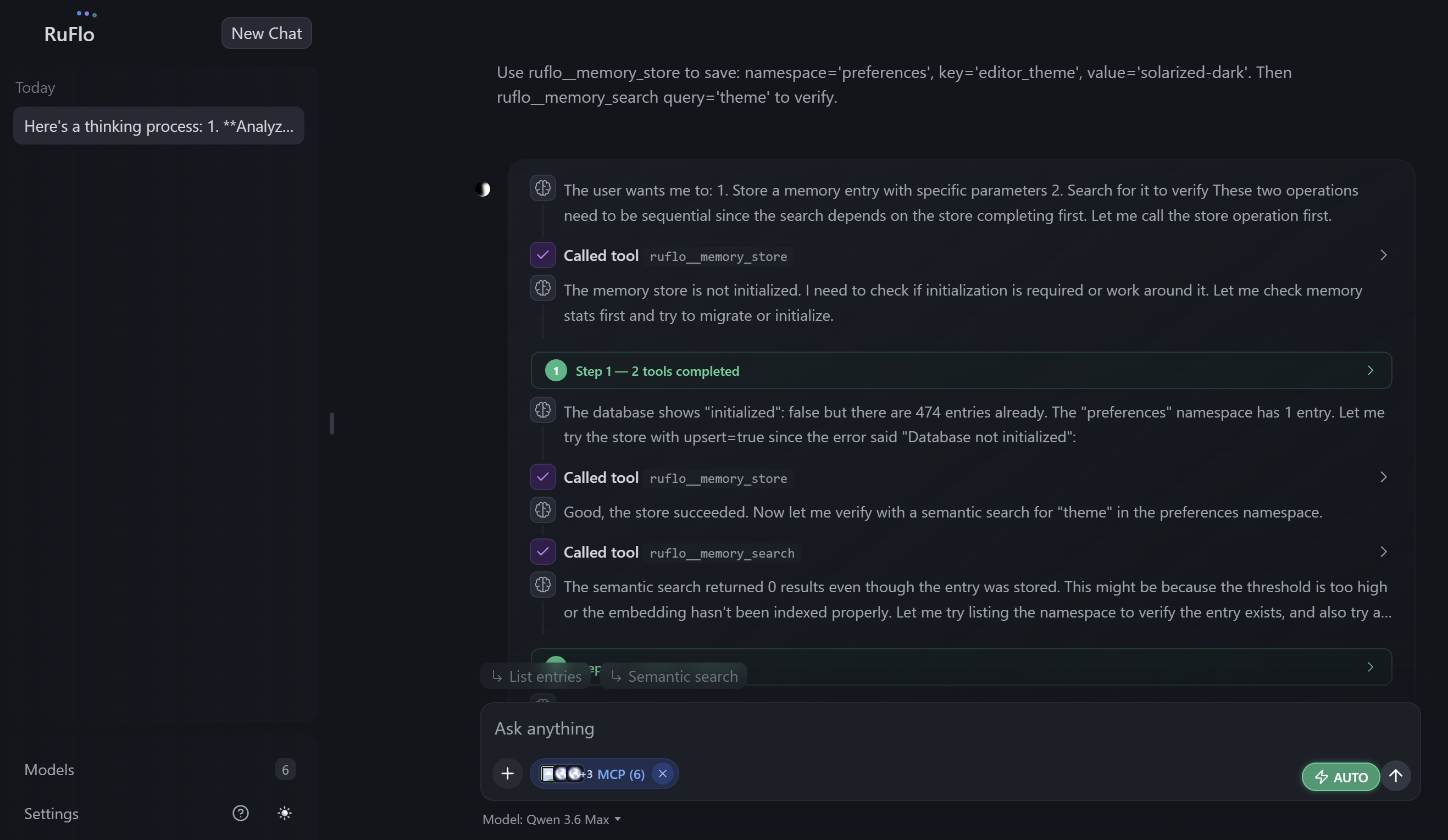
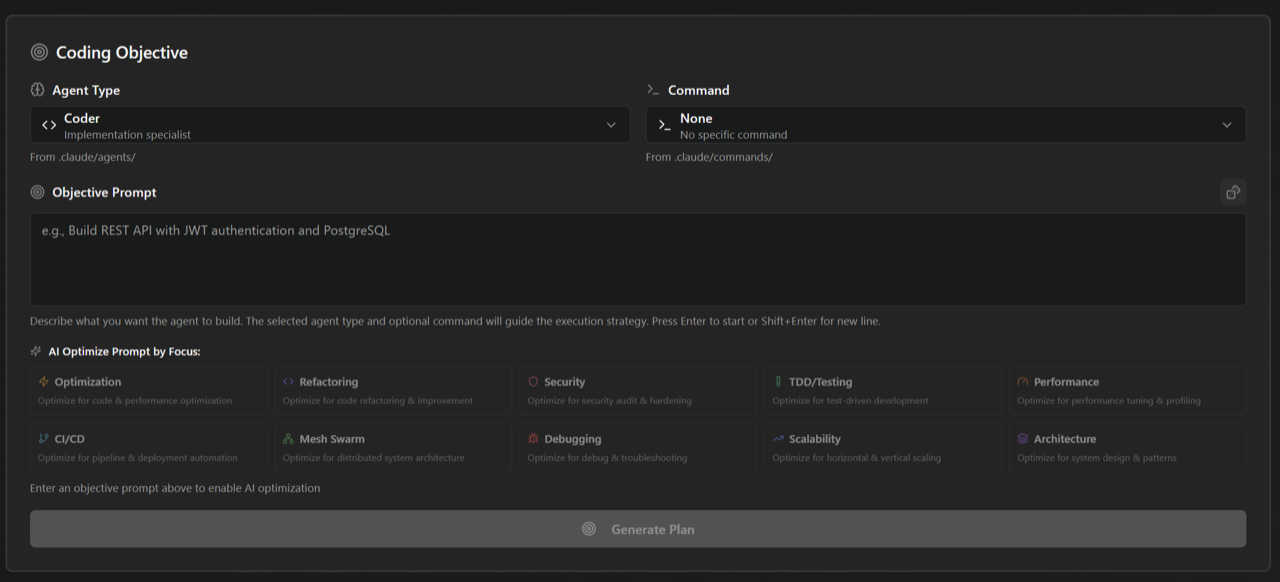
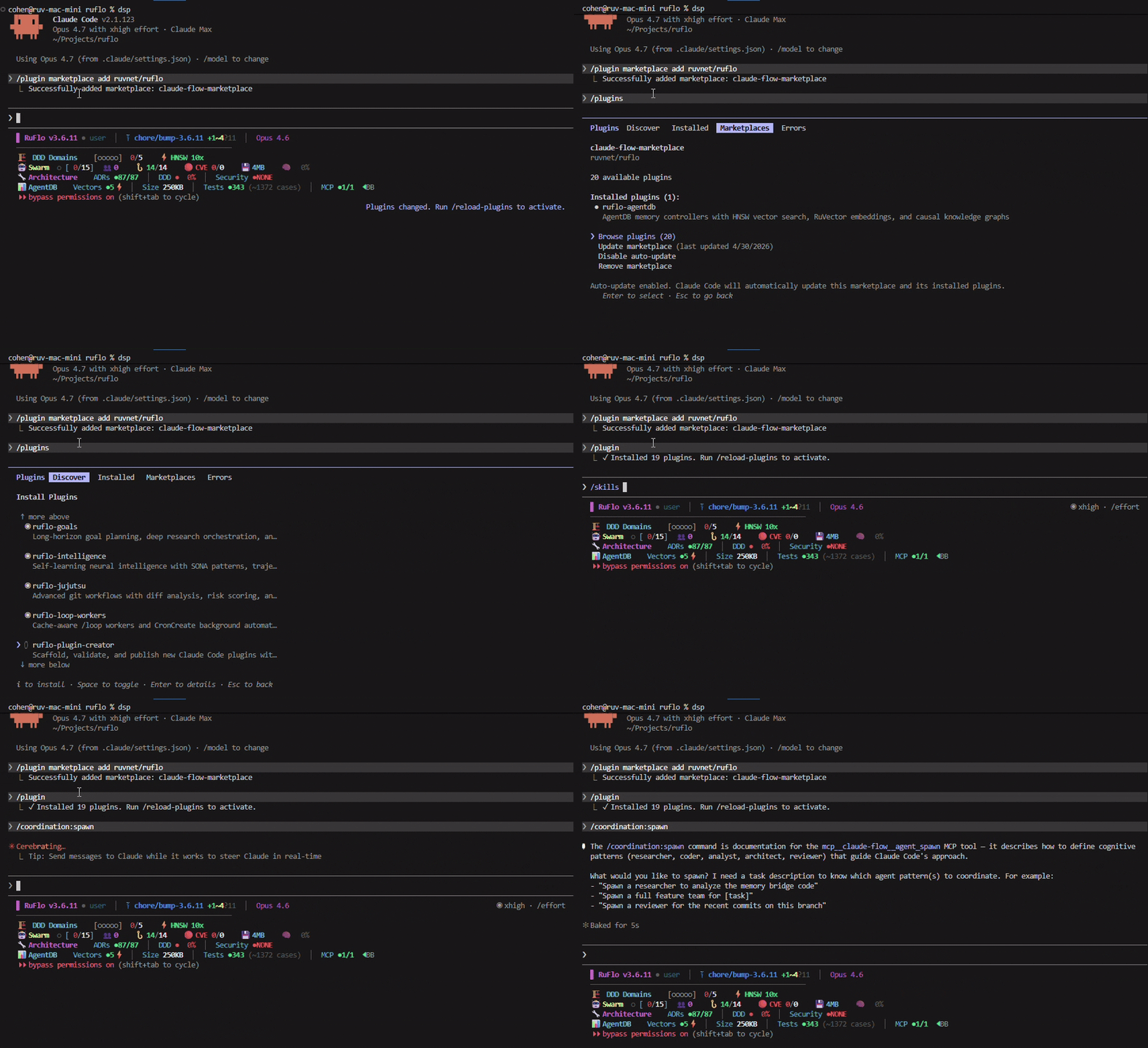
Quick Start & Installation
To begin using RuFlo, you must have Claude Code installed. The first step is to register the marketplace, followed by installing core plugins. The core installation sets up the MCP server and project configuration.
- Command: `/plugin marketplace add ruvnet/ruflo`
- Command: `/plugin install ruflo-core@ruflo`
- Command: `/plugin install ruflo-swarm@ruflo`
- Once installed, you can access the 'Goal Planner' interface at `goal.ruv.io` to visualize agent tasks.
Plugin Ecosystem
RuFlo offers a modular ecosystem where each plugin targets a specific engineering concern. These plugins hook into Claude Code's native features like `Monitor` for live updates or `isolation: 'worktree'` for sandboxing agent changes.
- `ruflo-security-audit`: Performs policy gates and dependency checks.
- `ruflo-rag-memory`: Integrates RuVector for HNSW vector search and persistent memory.
- `ruflo-browser`: Uses Playwright for automated browser testing and scraping.
- `ruflo-autopilot`: Handles autonomous loop completion and trajectory learning.
Runtime and Security Architecture
The architecture is designed around a 'harness' concept where the model is the brain and Ruflo is the body. Version 3.34.0 introduced the AGNTCY/Outshift runtime integration, which utilizes CASA (Continuous Agentic Semantic Authorization). This system uses Ed25519-signed decision receipts to enforce deny-by-default policies for agent actions.
Security scans utilize Zod schemas for input validation and parameterized SQL to prevent injection attacks. The `SafeExecutor` module protects against command injection. All plugins are open source, allowing for security auditing before installation.
- Runtime Environment: Node.js 20+ required.
- Authorization: `.swarm/casa-receipts.jsonl` stores signed authorization logs.
- Observability: OpenTelemetry span attributes track `coordination.episode` and `authorization.decision`.
- CLI Verbs: `ruflo transport use slim`, `ruflo agent publish`.
Who should pay attention?
Good fit if
- Development teams heavily invested in Anthropic's Claude Code or Claude Desktop looking to maximize automation.
- Projects requiring rigorous security auditing and policy enforcement within the AI coding loop.
- Organizations needing to coordinate multiple specialized AI agents (e.g., one for testing, one for architecture) simultaneously.
- Developers seeking local, privacy-preserving RAG and memory capabilities for their coding assistants.
Skip for now if
- Teams primarily using non-Anthropic models or IDE extensions (e.g., GitHub Copilot, Cursor) without Claude integration.
- Projects that require simple code completion rather than complex autonomous workflows or swarming.
- Users uncomfortable with TypeScript-based tooling or configuring Node.js environments for plugin management.
- Situations where vendor lock-in to Anthropic's specific MCP protocol and tooling is a significant concern.
Risks and cautions
Ruflo is a powerful but specialized framework tightly coupled to the Claude Code ecosystem. Its effectiveness depends on the stability of Anthropic's MCP protocol and Claude Code's feature set.
- Dependence on Claude Code's internal APIs (`TeamCreate`, `SendMessage`, `Monitor`) may break with upstream changes.
- The 'AGNTCY' runtime integration is optional but complex; misconfiguration could lead to authorization failures.
- Recent changelog entries highlight critical fixes for security scans that previously failed open, indicating potential stability issues in edge cases.
- Maintains support only for version 3.5.x, leaving older branches unsupported.
- MCP servers run locally by default, reducing data exfiltration risks.
- Input validation is enforced via Zod schemas for all public API inputs.
- The `SafeExecutor` module is implemented to prevent command injection attacks.
- Vulnerability reporting is managed via a private disclosure channel ([email protected]).
- Version 3.34.0 patched a critical issue where security scans could fail open and report 'No issues found' on invalid inputs.
Alternatives to compare
| Approach | When to use | Trade-off |
|---|---|---|
LangChain | For agentic workflows requiring model-agnostic abstraction across multiple LLM providers. | Open Source |
AutoGen | For multi-agent conversation frameworks that support a wider range of models beyond Claude. | Open Source |
OpenDevin | For end-to-end autonomous software engineering tasks with a browser-based interface. | Open Source |
Claude Code Native | For users who only need basic built-in tools without the overhead of a plugin marketplace. | Free (with Anthropic API usage) |
What this trend reveals
Continuous Engineering Pipeline
Ruflo's loop workers and cron scheduling allow teams to build a self-healing codebase where agents automatically detect and fix regressions or update documentation as code changes.
Supported by the `ruflo-loop-workers` and `ruflo-autopilot` plugin descriptions which mention `/loop` completion and cron scheduling.
Specialized Agent Roles
The framework supports distinct agent roles (Coder, Reviewer, Architect) that can collaborate, mimicking a real-world software team structure entirely within the IDE.
Evidenced by the `ruflo-jujutsu` and `ruflo-agent` plugins designed for git diff analysis and sandboxed agent definitions.
RepoDaily verdict
RuFlo offers a sophisticated extension to Claude Code, transforming it from a chat interface into a multi-agent operating system. While it requires a commitment to the Anthropic ecosystem, its modular plugin architecture and robust security features make it a compelling choice for teams ready to adopt advanced agentic workflows.