
Primary question: Do you need full control over your reading data with hardware device integration?
RepoDaily adoption score
RepoDaily rates this as 86/100 (strong) for adoption: evidence, installation path, production risk, differentiation, license clarity, and AI/agent fit are scored from the article sources and adoption notes.
5 source(s) across 3 source category/categories, plus a RepoDaily-specific evidence module when available.
4 workflow step(s), 3 next-action step(s), and 5 command/install signal(s) were detected.
Trending momentum is +296 stars, with maintenance/release/issue signals counted when present.
Risk is marked medium, with 4 security note(s) and 4 explicit skip condition(s).
2 opportunity lens item(s), 3 alternative(s), and 3 type-specific section(s) support differentiation.
License source or license wording is present.
1 AI/agent-related signal(s) were detected in the article text and metadata.
Project overview
BookOrbit is a self-hosted library and reading platform designed to manage ebooks, PDFs, audiobooks, and comics. It provides built-in web readers for various formats including EPUB, KEPUB, MOBI, AZW3, AZW, FB2, PDF, CBZ, CBR, CB7, and audio formats M4B, MP3, M4A, OPUS, OGG, FLAC, eliminating the need for additional plugins.
The platform offers three-way synchronization between Kobo devices, KOReader, and the BookOrbit web reader. Reading progress, highlights, and annotations flow bidirectionally, allowing users to switch devices without losing their place.
Beyond reading, BookOrbit includes 14 metadata providers, reading statistics and achievements, OPDS and Send-to-Kindle delivery, multi-user accounts with OIDC/SSO support, and automatic sync integration with external services like Hardcover, Readwise, and StoryGraph.
Why it is trending now
- Trending as a self-hosted alternative to commercial reading platforms like Kindle or Kobo Plus
- Implements complex three-way synchronization between e-readers, KOReader, and web clients
- Offers extensive format support for ebooks, comics, and audiobooks without external plugins
- Gained popularity due to increasing demand for data ownership in digital libraries
Problem it solves
- Commercial reading platforms lock users into ecosystems and control metadata
- Existing self-hosted solutions often lack hardware integration with Kobo and KOReader
- Managing progress across multiple devices and formats is fragmented
- Users want reading statistics and achievement tracking outside of vendor lock-in
How it works
- Deploy the application using Docker Compose, which sets up the main application and a PostgreSQL database with pgvector extension
- Upload ebooks, PDFs, audiobooks, and comics to the library, where the platform automatically fetches metadata from 14 providers
- Read content via the built-in web reader or connect Kobo devices and KOReader to sync progress and annotations
- Configure external integrations to sync reading data to services like Readwise or deliver files via Send-to-Kindle
Product demo and interface preview
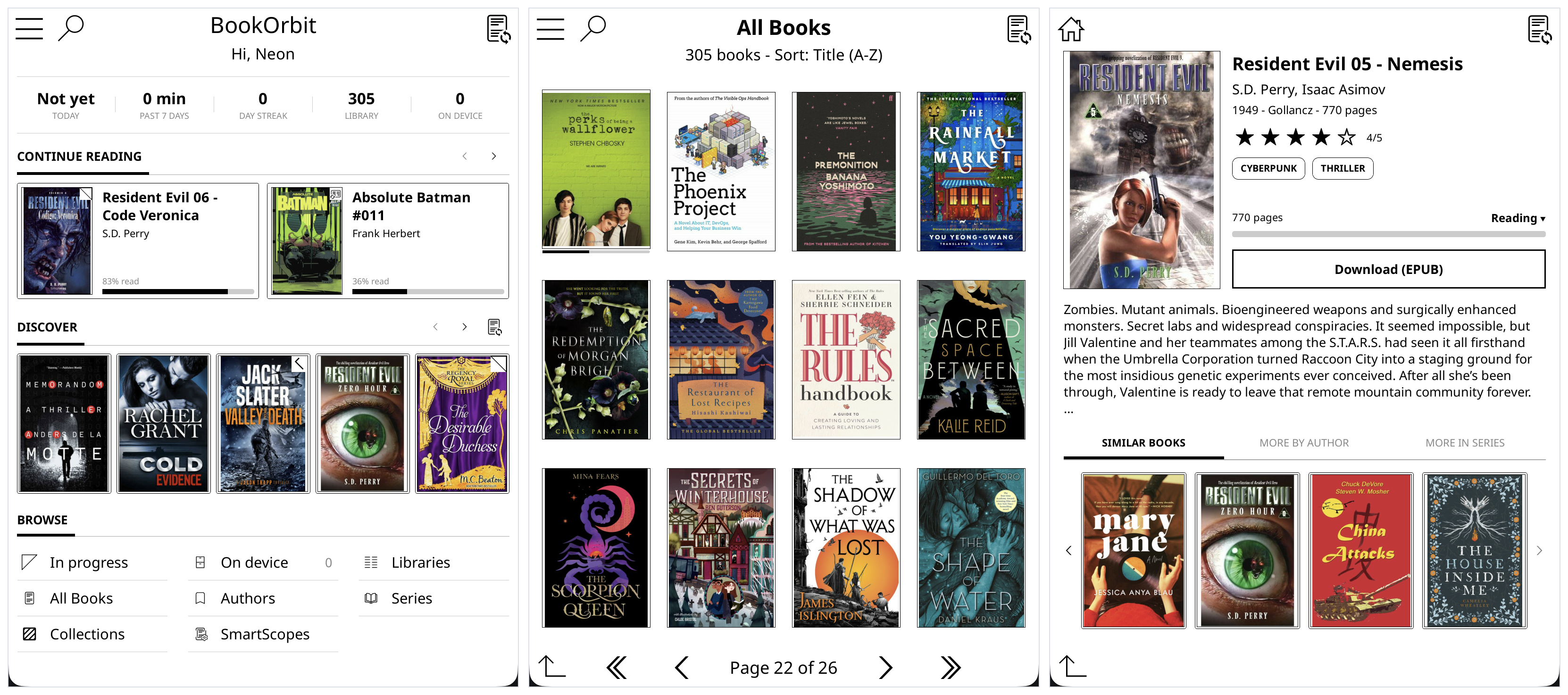
Deployment and Infrastructure
BookOrbit uses a multi-stage Docker build process with a Node.js 26 Alpine base image. The runtime environment includes `poppler-utils` for PDF processing, `ffmpeg` for media handling, and a Python virtual environment for the `kobo-cloudscraper` dependency.
The production Docker Compose configuration spins up two services: the application and a `pgvector/pgvector:pg18` database. The application service enforces security by running with a read-only root filesystem, dropping all Linux capabilities except specific ones like `CHOWN` and `DAC_OVERRIDE`, and enabling the `no-new-privileges` security option.
- Container exposes port 3000 with a healthcheck on `/api/v1/health`
- Environment variables `DATABASE_URL`, `JWT_SECRET`, and `SETUP_BOOTSTRAP_TOKEN` are required
- Volumes are mapped for book storage (`/books`) and application data (`./data/app`)
- Entrypoint script `entrypoint.sh` is executed via `tini` for signal handling
Ecosystem and Integrations
The platform supports OIDC/SSO for multi-user authentication and allows exporting data via OPDS feeds. It connects to external reading trackers like Hardcover, Readwise, and StoryGraph to keep statistics synchronized across services.
- Send-to-Kindle functionality enables wireless delivery of content
- KOReader plugin provides on-device library access and sync
- Kobo integration uses `kobo-cloudscraper` for handling sync protocols
Development and Build Architecture
The project is structured as a monorepo using pnpm workspaces. It requires Node.js version 24 or higher and pnpm version 11 or higher. The build process separates the client and server compilation stages, using `pnpm deploy` to create a production-optimized bundle with only necessary dependencies.
Development scripts allow running the client and server concurrently via `concurrently`. The codebase enforces code quality using `lint-staged`, `eslint`, and `prettier`, and includes coverage reporting via Codecov.
- Scripts: `pnpm dev` (all services), `pnpm build:client`, `pnpm build:server`, `pnpm db:migrate`
- License is AGPL-3.0, requiring source sharing for network deployments
- Type checking is enforced for both client and server packages
- CI/CD workflows are defined for continuous integration and release management
Who should pay attention?
Good fit if
- Individuals with a large collection of local ebooks wanting centralized management
- Users of Kobo e-readers and KOReader seeking unified progress tracking
- Privacy-conscious readers wanting to host their own reading data
- Communities or families looking to share a library with separate user accounts
Skip for now if
- Users completely satisfied with commercial cloud-based reading platforms
- Those without hardware capable of running Docker or managing a database
- Users requiring native mobile apps (currently web-based)
- Teams looking for enterprise-grade DRM management support
Risks and cautions
The project requires self-hosting infrastructure and database management, which may pose challenges for non-technical users.
- Dependency on Docker and PostgreSQL with pgvector extension
- Complex configuration involving environment variables and file paths
- AGPL-3.0 license requires sharing source modifications for network deployments
- No native mobile applications, relying on web interface
- Application container runs with `read_only` root filesystem and `tmpfs` for `/tmp`
- Docker configuration drops all capabilities and adds only specific necessary ones
- Security option `no-new-privileges:true` is enabled to prevent privilege escalation
- Healthcheck endpoint uses `localhost` to minimize external exposure risks
Alternatives to compare
| Approach | When to use | Trade-off |
|---|---|---|
Kavita | Users prefer a focus on comics and manga with a polished UI | Open-source |
Calibre | Users need comprehensive library management with desktop software integration | Open-source |
Readarr | Automating the download and management of ebooks for a library | Open-source |
What this trend reveals
Data Sovereignty
As digital rights management and data collection by commercial platforms increase, readers are seeking self-hosted solutions that provide full control over their libraries and reading habits.
The AGPL-3.0 license and self-hosting requirement cater to privacy-focused users and those wanting to exit vendor lock-in ecosystems.
E-Reader Integration
The market lacks robust tools that integrate open-source e-reader software like KOReader with cloud-based management.
BookOrbit's three-way sync specifically addresses this gap by syncing progress between Kobo, KOReader, and the web.
RepoDaily verdict
BookOrbit is a compelling choice for readers who prioritize data ownership and hardware integration, offering a unique three-way sync that bridges the gap between self-hosted libraries and physical e-readers.