
Primary question: Do you want to replace black-box vector-store retrieval with a browsable, trajectory-logged filesystem of agent context?
RepoDaily adoption score
RepoDaily rates this as 90/100 (strong) for adoption: evidence, installation path, production risk, differentiation, license clarity, and AI/agent fit are scored from the article sources and adoption notes.
6 source(s) across 4 source category/categories, plus a RepoDaily-specific evidence module when available.
5 workflow step(s), 5 next-action step(s), and 8 command/install signal(s) were detected.
Trending momentum is +803 stars, with maintenance/release/issue signals counted when present.
Risk is marked medium, with 5 security note(s) and 3 explicit skip condition(s).
3 opportunity lens item(s), 4 alternative(s), and 3 type-specific section(s) support differentiation.
License source or license wording is present.
6 AI/agent-related signal(s) were detected in the article text and metadata.
Project overview
OpenViking, published by volcengine under a security policy that routes directly to the ByteDance security team, is an open-source context database for AI agents. Its core move is structural: memories, resources, and skills all become entries in one virtual filesystem addressed with viking:// URIs. An agent does not fire a query into a black-box vector store and receive floating chunks back — it browses its own context with ls, tree, and find, the same way a developer moves through a repository. The repo pulled 803 stars in the trend window at rank 4, and the design, not marketing, is the reason.
Every entry written into the system is processed into three tiers: L0 abstract, L1 overview, and L2 details. Retrieval loads only as deep as the task requires, which attacks token spend head-on. Instead of stuffing full documents into a context window, an agent reads an L0 abstract, decides a directory is worth pursuing, and pulls L1 or L2 only when the task justifies it.
Retrieval itself is directory-recursive. Vector search first locates the highest-scoring directory, then the system drills down layer by layer, so results arrive with their surrounding context intact rather than as orphaned fragments. Critically, each query preserves its directory-browsing trajectory. When an answer looks wrong, you can see exactly which path produced it — turning retrieval debugging from guesswork into inspection.
Distribution is wider than a typical single-package repo. RELEASE.md documents ten artifact lines: the openviking Python package (local runtime, server, CLI), the openviking-sdk Python client, the @openviking/sdk TypeScript client, the Rust ov CLI shipped via npm as @openviking/cli, the mcp-server-openviking-controlplane MCP server with its ov-cp CLI, OpenClaw/ClawHub and OpenCode plugins, multi-architecture Docker images on GHCR and Docker Hub, TOS release assets, and VikingBot. The project is licensed AGPLv3 per the README badge, and that single fact shapes who can adopt it.
Why it is trending now
- 803 stars in the 2026-08-20 trend window at rank 4, with a Trendshift badge on the README.
- The viking:// filesystem reframes agent context as files an agent can ls, tree, and find — a concrete alternative to black-box vector stores.
- L0/L1/L2 tiered loading targets a cost every agent team measures: tokens per retrieval.
- The OpenViking Studio playground at openviking.ai/studio runs in a browser with no installation, removing the usual first-hour friction.
- The integration surface is wide for a project on a pre-1.0 line: MCP control plane, OpenClaw/ClawHub plugin, OpenCode plugin, npm CLI, and Python plus TypeScript SDKs.
Problem it solves
- Vector-store retrieval returns chunks without provenance; a wrong answer cannot be traced to the path that produced it.
- Memory, knowledge RAG, and skills typically live in three systems with three APIs and no shared addressing scheme.
- Flat retrieval loads whole documents even when the task only needs a summary, inflating token spend.
- Agent failures stay opaque because retrieval internals are not observable.
How it works
- Install the openviking package, then run openviking-server init — an interactive wizard that picks providers and writes ~/.openviking/ov.conf — and validate the result with openviking-server doctor.
- Write context: memories, resources, and skills each receive a viking:// URI; on write, each entry is processed into L0 abstract, L1 overview, and L2 details.
- Retrieve recursively: vector search locates the highest-scoring directory, then the system drills down layer by layer, returning results with surrounding context intact.
- Debug by trajectory: every query preserves its directory-browsing path, so a bad result points to the exact directory chain that produced it.
- Integrate: HTTP clients use openviking-sdk or @openviking/sdk, the ov CLI installs via npm (@openviking/cli) or cargo, and MCP, OpenClaw, and OpenCode plugins connect agent hosts.
Product demo and interface preview
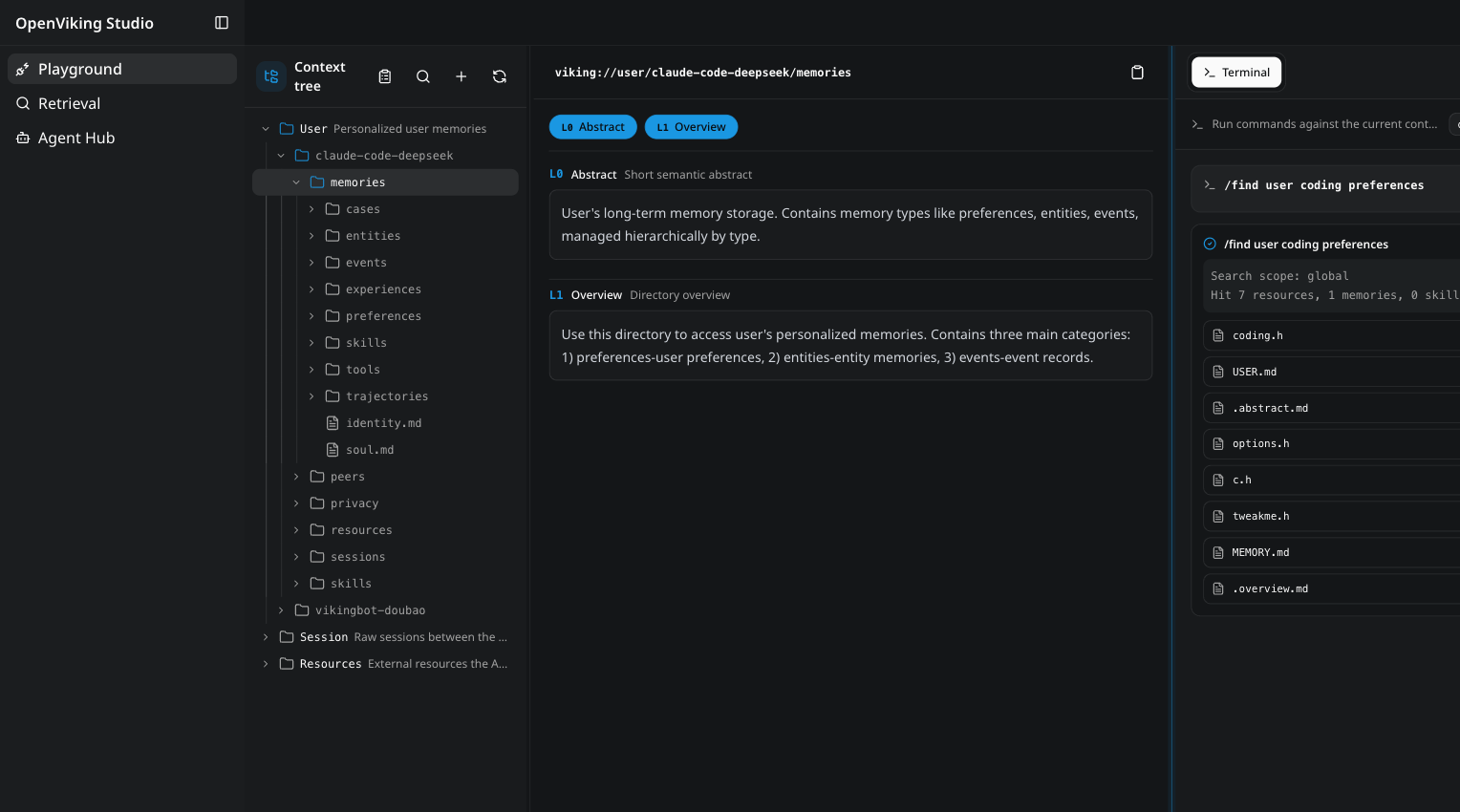
Try-it path: zero install first, then a local server
- Zero-install: open https://openviking.ai/studio in a browser; the README describes it as a live demo, no installation required.
- Local server: after installing the openviking package, run openviking-server init (writes ~/.openviking/ov.conf) and openviking-server doctor to validate.
- Verify the install with: python -c "import openviking; print(openviking.__version__)".
- CLI: npm i -g @openviking/cli downloads a pre-built binary; source builds use cargo install --path crates/ov_cli; connection config lives in ~/.openviking/ovcli.conf.
- Development setup uses uv: uv sync --all-extras; native changes require uv pip install -e . --force-reinstall to rebuild the AGFS/RAGFS Rust bindings, the bundled Rust CLI, and C++ components.
- Pre-compiled wheels cover Windows x86_64, macOS x86_64 and arm64, and Linux x86_64 and arm64 (manylinux); other platforms compile from source during pip install.
Integration surface: the artifacts that actually ship
- openviking (PyPI): local runtime, server, CLI, and the full feature set; main releases tag vX.Y.Z, with v0.3.26 cited as the format example.
- openviking-sdk (PyPI) and @openviking/sdk (npm): lightweight HTTP clients for an existing OpenViking server, versioned on [email protected] and [email protected] tags.
- @openviking/cli (npm) and the Rust ov CLI: [email protected] tags (example [email protected]); described as a high-performance client for the server.
- mcp-server-openviking-controlplane: MCP server plus the ov-cp CLI for the control plane.
- OpenClaw/ClawHub plugin (date-based tags like YYYY.M.D or YYYY.M.D-N, dev channel YYYY.M.D-dev.N) and @openviking/opencode-plugin for OpenCode.
- Multi-architecture Docker images publish to GHCR (ghcr.io/<owner>/<repo>) and Docker Hub (<dockerhub-user>/openviking); TOS hosts source archives, install scripts, and a stable latest path.
- VikingBot ships through openviking[bot] and the official Docker image; RELEASE.md notes historical standalone release entries are documented separately to avoid misuse.
Maintenance risk: toolchain and versioning
- Building from source needs Rust 1.91.1+ (packaging builds the bundled ov CLI), a C++17 compiler (GCC 9+ or Clang 11+), CMake 3.15+, and Python 3.10+; Go 1.22+ is only required for the Go SDK under sdk/go.
- Versions resolve from Git tags via setuptools_scm; the main package matches vX.Y.Z while the Python SDK matches only python-sdk@*, which prevents tag collisions by design.
- The example main tag v0.3.26 marks a pre-1.0 line; the release guide also defines a republish path (_Publish Distribution by build run id) and manual dispatch targets (none, testpypi, pypi, both) — thorough documentation, but also a measure of how much release machinery exists.
- The repo mixes a Python workspace (pyproject.toml) and a Rust workspace (Cargo.toml) with C++ extensions underneath — three toolchains to keep green.
Who should pay attention?
Good fit if
- Agent builders whose hardest failures are untraceable retrieval; per-query trajectories make the failure path visible.
- OpenClaw or OpenCode users — dedicated plugin distributions exist for both hosts.
- Token-cost-sensitive deployments where L0-abstract-first loading shrinks what enters the context window.
- Anyone who wants to test the interaction model before installing anything — Studio runs in the browser.
Skip for now if
- Closed-source products that cannot absorb AGPLv3 obligations; the LICENSE badge is AGPLv3, so legal review precedes engineering.
- Platforms without a matching pre-compiled wheel and without Rust 1.91.1+, C++17, and CMake 3.15+ toolchains; pip will build from source.
- Simple embedding-store needs; a dedicated vector database delivers that with less machinery and no skills layer.
Risks and cautions
The runtime is inspectable and the release engineering is unusually well documented, but AGPLv3, a three-toolchain source build, and ten artifact lines raise the real cost of running it in production.
- AGPLv3 licensing (README badge) can restrict embedding in closed-source products; legal review should come before any engineering spike.
- Source builds require Rust 1.91.1+, a C++17 compiler (GCC 9+ or Clang 11+), and CMake 3.15+; only Windows x86_64, macOS x86_64/arm64, and Linux x86_64/arm64 manylinux have pre-compiled wheels.
- Ten artifact lines (main package, Python SDK, TypeScript SDK, Rust/npm CLI, MCP control plane, OpenClaw plugin, OpenCode plugin, Docker images, TOS assets, VikingBot) each carry their own tag namespaces, so version alignment is on the operator.
- The main package sits on a pre-1.0 line (tag example v0.3.26), and RELEASE.md explicitly quarantines VikingBot's historical standalone entries to avoid misuse — a signal of past packaging churn.
- Vulnerabilities are reported to the ByteDance security center (security.bytedance.com/src) or [email protected]; the policy explicitly says do not open public GitHub Issues for security matters.
- Reports are assessed with CVSS 3.1, and ByteDance asks researchers not to publish details until remediation and user notification are complete.
- A bug bounty policy is published under the ByteDance Security Response Center handling rules.
- The docs site covers deployment, authentication, encryption, and telemetry alongside the API reference.
- License is AGPLv3 per the README badge — verify compatibility obligations before shipping anything derived from it.
Alternatives to compare
| Approach | When to use | Trade-off |
|---|---|---|
Mem0 | You want a focused memory layer for agents rather than a full context filesystem with skills. | Open source with a managed cloud tier |
Letta (MemGPT) | You want agents that manage their own memory through an OS-style core with self-editing context. | Open source with a hosted offering |
Zep | Temporal knowledge-graph memory across long sessions matters more than filesystem-style browsing. | Open source with a managed service |
Chroma | You just need an embedding database and have no requirement for skills, tiers, or retrieval trajectories. | Open source with a hosted mode |
What this trend reveals
Retrieval debugging as a first-class feature
Because agents browse context with ls, tree, and find under viking://, every retrieval leaves a directory path you can audit. Wrong answers stop being mysteries and become traceable chains.
In the Studio playground, run the same query twice with different phrasing and compare the directory trajectories; a bad result should point to a specific path you can inspect.
Token-cost control via layer depth
L0 abstract, L1 overview, and L2 details are built on write and loaded on demand, so token spend scales with task depth instead of document size.
On your own corpus, measure tokens consumed for L0-only loads versus L2 loads, then compare against your current RAG pipeline's per-query cost.
Skills as filesystem citizens
Skills share the same viking:// URI space as memories and resources, which means one addressing scheme covers knowing, remembering, and doing.
Write one skill and one memory entry, then confirm both are reachable through the same find command in the Studio playground.
RepoDaily verdict
OpenViking is the rare agent-memory project whose core claim — browse context like files, debug retrieval like paths — you can verify in a browser tab. AGPLv3 and the Rust/C++/CMake source-build requirements set a real adoption bar, but observable retrieval trajectories and L0/L1/L2 tiered loading make it a strong candidate wherever agents fail silently today.