
Primary question: Do these five SKILL.md modules hold up on your own prompts before you pin versions and standardize on the collection?
RepoDaily adoption score
RepoDaily rates this as 90/100 (strong) for adoption: evidence, installation path, production risk, differentiation, license clarity, and AI/agent fit are scored from the article sources and adoption notes.
5 source(s) across 4 source category/categories, plus a RepoDaily-specific evidence module when available.
5 workflow step(s), 5 next-action step(s), and 3 command/install signal(s) were detected.
Trending momentum is +413 stars, with maintenance/release/issue signals counted when present.
Risk is marked medium, with 5 security note(s) and 3 explicit skip condition(s).
3 opportunity lens item(s), 4 alternative(s), and 5 type-specific section(s) support differentiation.
License source or license wording is present.
6 AI/agent-related signal(s) were detected in the article text and metadata.
Project overview
Garden Skills is ConardLi's curated collection of production-ready Agent Skills for Claude Code, Cursor, Codex, and other SKILL.md-compatible coding agents. It earned 413 stars in the 2026-08-28 trend window (rank 12) by doing one unglamorous thing well: packaging reusable agent behaviors as versioned, checksummed modules instead of prompt snippets scattered across chat logs. The repo ships five skills — web-video-presentation, web-design-engineer, gpt-image-2, beautiful-article, and kb-retriever — each in its own folder under skills/ with a required SKILL.md spec and manifest.json.
The engineering discipline is unusual for promptware. CONTRIBUTING.md documents a monorepo where every skill carries the same minimal shape: SKILL.md (the agent-facing contract), manifest.json (name, version, category, compat), trilingual READMEs, and optional references/, scripts/, templates/, and themes/ directories. The root package.json is deliberately boring — @conardli/garden-skills at version 0.0.0, private, no runtime dependencies, engines.node >= 20. npm install is a no-op; the release tooling is pure ESM Node with zero dependencies.
What you actually install is per skill. Releases are tag-driven per skill: cut-release.mjs packs a versioned .zip plus a .sha256 checksum, update-readme.mjs rewrites the download links inside the READMEs, and validate-skills.yml runs the same checks on every pull request that CI runs. Install routes include the skills CLI via npx, the Claude Code plugin marketplace (backed by .claude-plugin/marketplace.json), a pinned .zip from GitHub Releases, manual copy into your project, or a git submodule.
The flagship skill, web-video-presentation, shows the ambition. It builds record-ready Vite + React + TypeScript presentations on a fixed 1920×1080 stage that scales to the viewport, drives scenes with a click/keyboard (chapter, step) cursor carrying one narration beat per visual step, pauses at hard collaboration checkpoints for script, theme, outline, implementation mode, and optional synthesized narration audio, and ships 23 built-in themes. That is a concrete deliverable, not a demo prompt.
Why it is trending now
- 413 stars in the 2026-08-28 trend window, trending rank 12.
- Rides the SKILL.md spec (agentskills.io) that Claude Code, Cursor, and Codex now load natively — agents pick skills by description, so a well-written collection compounds in usefulness.
- Five distinct skills in one repo: web design, video presentation, image generation, article formatting, and knowledge retrieval.
- MIT license plus zero runtime dependencies: npm install is a no-op, shrinking the audit surface to readable markdown and scripts.
- Trilingual documentation — English, zh-CN, and ja-JP — for both the collection index and the contributor guide.
Problem it solves
- Writing a good SKILL.md — frontmatter name/description that triggers at the right moment plus references an agent loads on demand — is fiddly, and most developers rewrite it from zero every time.
- Prompt modules shared as gists or chat pastes carry no versions, no checksums, and no compatibility declaration; garden-skills' manifest.json records name/version/category/compat per skill.
- Keeping download links pointed at current zips is manual labor elsewhere; here update-readme.mjs and readme:check keep README links in sync with manifests under CI.
- Skill collections need per-skill releases, not repo-wide tags; release-skill.yml is tag-driven per skill.
How it works
- Pick a skill from skills/ — each folder (e.g., skills/web-video-presentation/) holds the required SKILL.md and manifest.json plus optional references/, scripts/, templates/, and themes/.
- The agent reads SKILL.md frontmatter (name, description) to decide when the skill applies, then loads the folder's references on demand.
- Install it your way: skills CLI via npx, Claude Code plugin marketplace, pinned .zip from Releases, manual copy into your project, or git submodule.
- Maintainers version per skill in skills/<name>/manifest.json; cutting a release with npm run release packs a .zip + .sha256 and rewrites README download links.
- Every pull request passes npm run validate (list + pack:all + readme:check) via validate-skills.yml.
Product demo and interface preview

Repository anatomy: five skills, one contract
Every skill follows the same minimal shape documented in CONTRIBUTING.md: SKILL.md (YAML frontmatter with name and description, then instructions), manifest.json (name/version/category/description/compat), README.md plus zh-CN and ja-JP variants, and optional references/, scripts/, and assets directories. The uniformity matters because agents depend on the frontmatter contract — the description field is what the agent uses to decide whether to load the skill at all.
Around the skills sits maintainer infrastructure: scripts/release/ holds cut-release.mjs (the interactive release entry point), pack-skill.mjs (skill to versioned .zip + .sha256), update-readme.mjs (rewrites Download links), and list-skills.mjs (inspects manifests). Two GitHub workflows guard the repo — release-skill.yml for tag-driven per-skill releases and validate-skills.yml as PR guard rails — while .claude-plugin/marketplace.json registers the collection with the Claude Code plugin marketplace. demo/ holds openable demos and website/ holds standalone showcase sites.
Command surface: what you actually run
- Node >= 20 is required — stated in CONTRIBUTING.md's quick start and enforced by the engines field in package.json.
- npm install is a no-op: the repo has no runtime dependencies and the release tooling is pure ESM Node, zero deps.
- npm run list — shows all skills plus manifest status.
- npm run validate — runs npm run list && npm run pack:all && npm run readme:check, the same checks CI runs on every PR.
- npm run release and npm run release:dry — cut-release.mjs, with a dry-run flag for rehearsal.
- npm run pack / pack:all and readme:sync / readme:check — per-skill zip packing and README link sync.
- The root package @conardli/garden-skills stays private at version 0.0.0 on purpose; per-skill versions live in skills/<name>/manifest.json.
Try-it path: five install routes, one afternoon
- Option A: skills CLI via npx — the fastest way to add a skill to an agent project.
- Option B: Claude Code plugin marketplace, backed by .claude-plugin/marketplace.json.
- Option C: pinned .zip from GitHub Releases, each shipped with a .sha256 checksum for verification.
- Option D: manual copy of a skill folder into your project.
- Option E: git submodule, for repos that want the whole collection tracked.
- Verification pass from a clone: node --version (>= 20), npm run list, npm run validate.
Maintenance read: what could rot
- Single-maintainer project (ConardLi) producing English, Chinese, and Japanese docs — bus factor is one.
- Root version 0.0.0 and private: true mean there is no stable root artifact to depend on; pin releases per skill from skills/<name>/manifest.json.
- Counterweights: tag-driven per-skill releases with .sha256 checksums, CI that fails PRs on npm run validate errors, and a documented manual release fallback in CONTRIBUTING.md.
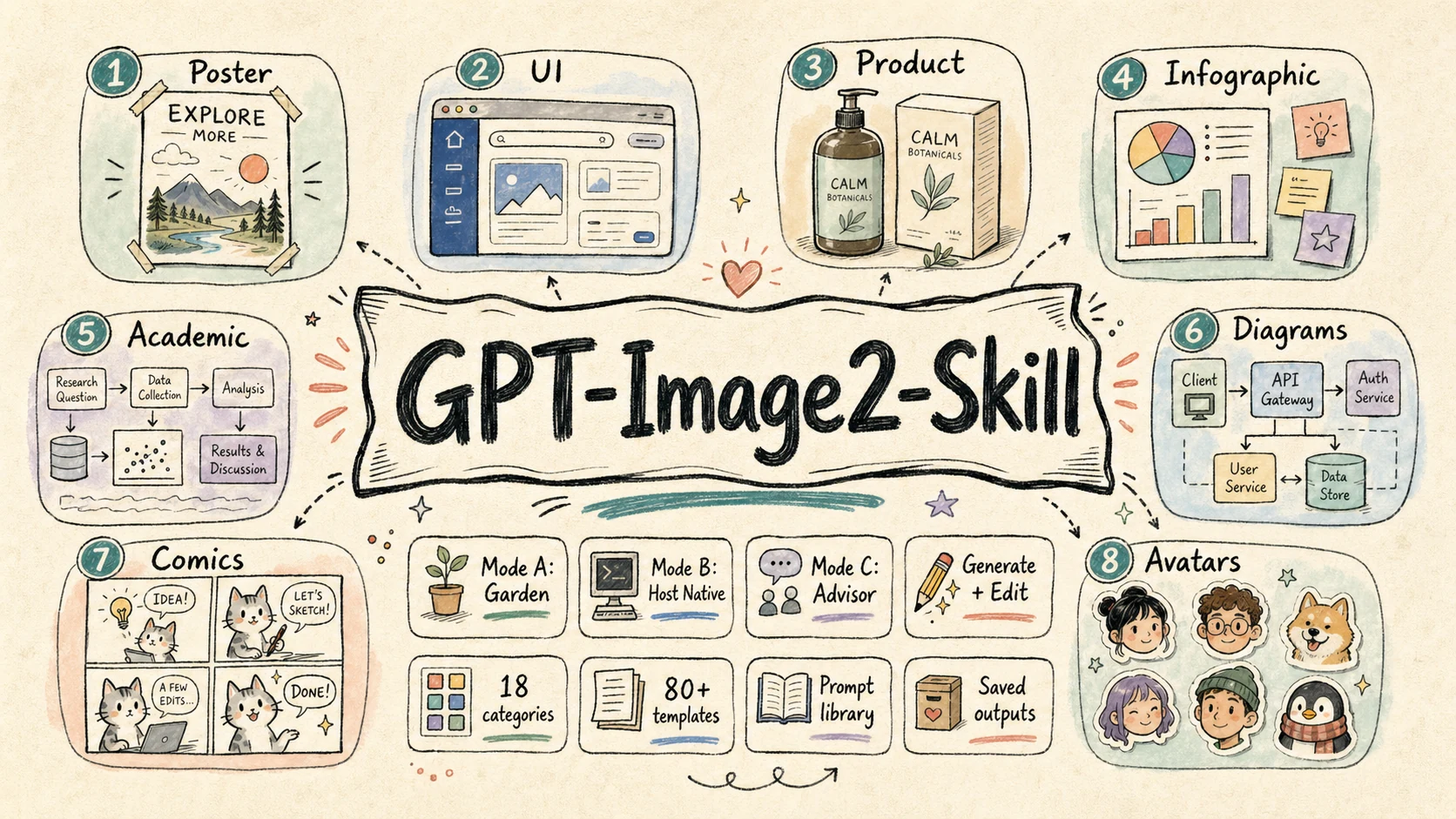
- Skill quality is bounded by the host model's instruction-following; the gpt-image-2 skill also depends on an external image-generation service, so output drift sits outside this repo's control.
Integration surface: where it plugs in
- Targets the Agent Skills spec (SKILL.md) — the README links both the Claude support article on Skills and agentskills.io.
- Named compatible agents: Claude Code, Cursor, Codex, and other SKILL.md-compatible agents; manifest.json carries a compat field per skill.
- web-video-presentation outputs Vite + React + TypeScript projects — fixed 1920×1080 stage, (chapter, step) cursor with one narration beat per visual step, hover-only progress controls, and 23 built-in themes on a theme-token architecture.
- Install integration points: npx CLI, Claude Code plugin marketplace manifest, Release zips with checksums, and git submodule.
Who should pay attention?
Good fit if
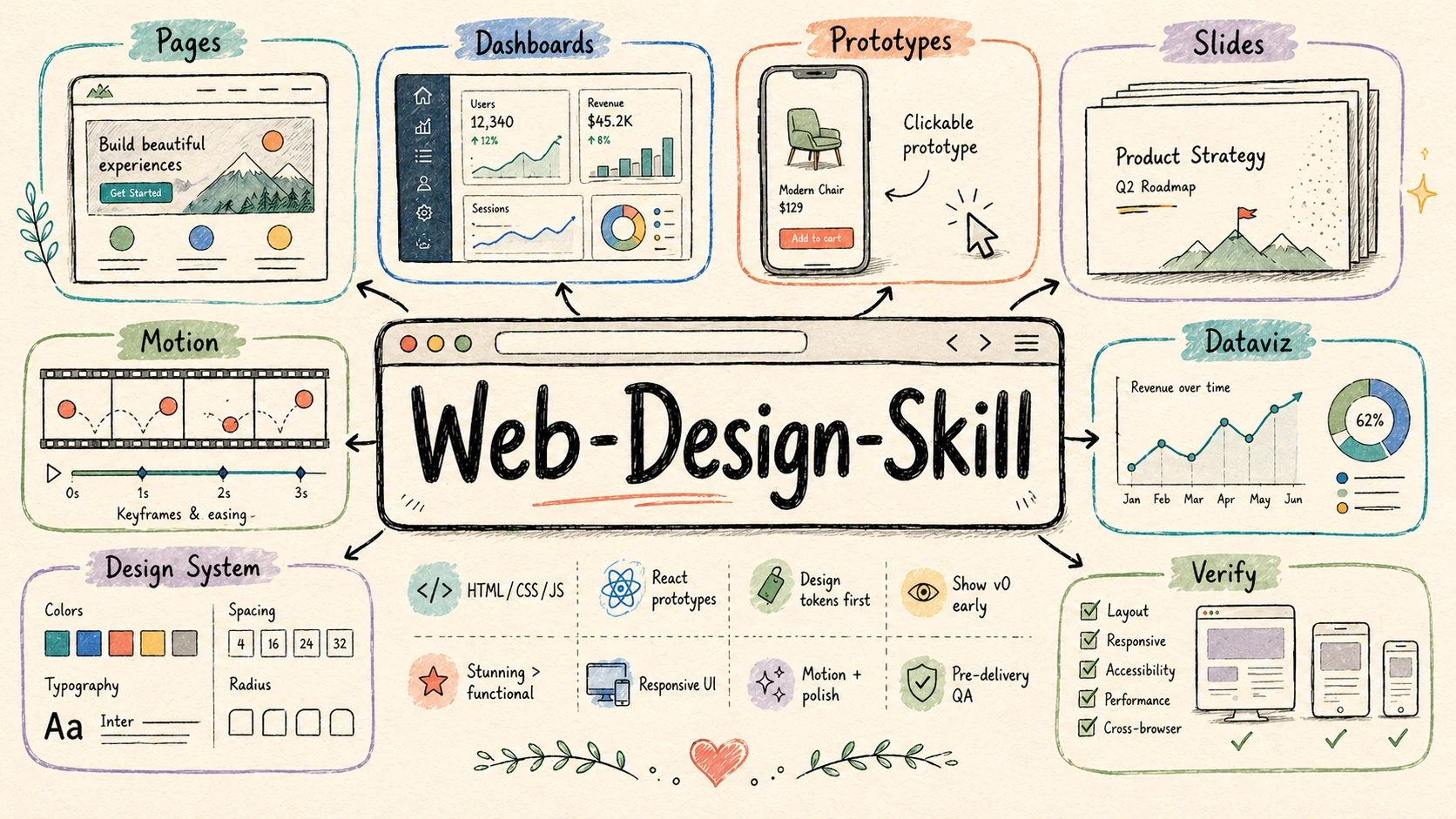
- Frontend developers on Claude Code, Cursor, or Codex who want web-design-engineer instead of rewriting design prompts per project.
- Speakers and educators turning articles into recordable presentations — web-video-presentation's checkpointed script/outline stages plus 23 themes are the whole point.
- Anyone who must read every line before running it: zero runtime dependencies and markdown-first skills make a full audit an afternoon task.
- Skill authors looking for a reference monorepo — the anatomy, validation, and per-skill release machinery are copyable.
Skip for now if
- Shops standardized on agents that do not load SKILL.md files — nothing here applies.
- Anyone needing vendor support or an SLA; this is a community MIT project.
- Anyone expecting a stable root npm package — the root is private at 0.0.0; consumption is per-skill zips or folder copies.
Risks and cautions
MIT-licensed, dependency-free, CI-guarded, and checksummed — but a single-maintainer collection whose root package sits at 0.0.0 and whose results depend on host-model behavior.
- Bus factor of one: ConardLi maintains the skills and three documentation languages.
- No root artifact to pin; stability lives per skill in manifest.json files you must read individually.
- Agent skill output varies with the host model and, for gpt-image-2, an external image service — the repo cannot guarantee results.
- Mitigants: MIT allows a fork you own; .sha256 checksums and validate-skills.yml make pinned releases reproducible.
- MIT license (copyright 2026) permits commercial use, modification, and redistribution with the notice retained.
- Supply-chain surface is minimal: no runtime dependencies, npm install is a no-op, and the release tooling is zero-dependency pure ESM Node.
- SKILL.md skills instruct an agent to act; optional scripts/ folders can contain executable helpers, so review a skill's scripts before letting an agent run with broad file access.
- Pinned .zip downloads from Releases ship .sha256 checksums you can verify before install.
- validate-skills.yml runs structural checks on every pull request, reducing malformed-manifest risk.
Alternatives to compare
| Approach | When to use | Trade-off |
|---|---|---|
anthropics/skills | You want Anthropic's official example skills as a baseline before depending on third-party collections. | Free, open source |
| You want a larger community collection of Claude Code skills with a different curation angle. | Free, open source | |
awesome-claude-code | You want a broad link list of Claude Code commands, skills, and tools rather than an installable collection. | Free, open source |
Hand-written SKILL.md in your own repo | Your prompts are proprietary or need strict review before leaving the company. | Engineering time only |
What this trend reveals
Fork a skill into a house style guide
web-design-engineer ships as readable SKILL.md plus references; fork it and encode your own design tokens and review rules instead of starting from a blank prompt.
Copy skills/web-design-engineer/ into your repo, edit the SKILL.md frontmatter and manifest.json, then run npm run list to confirm the manifest is detected.
Reuse the release tooling for your own skill monorepo
cut-release.mjs, pack-skill.mjs, and update-readme.mjs are zero-dep pure ESM Node scripts that can manage per-skill zips and checksums for any SKILL.md collection.
Run npm run pack on one skill, inspect the versioned .zip and .sha256 output, then wire the same commands into your CI.
A screen-recording pipeline without a video team
web-video-presentation builds Vite + React + TypeScript stages at 1920×1080 with checkpoint pauses and 23 themes; you screen-record the click-driven scenes instead of rendering video.
Feed it one short article, approve the script and outline checkpoints, record the scenes, and compare effort against your current slide tool.
RepoDaily verdict
Garden Skills is a small, disciplined bet: five MIT-licensed SKILL.md modules, per-skill versioning with checksummed zips, and zero-dependency tooling you can read in one sitting. Adopt a single skill first, pin its manifest version, and keep a fork ready in case the single maintainer goes quiet.