
Primary question: Does an early-beta, GPL-3.0 desktop runtime belong between you and the memory of your life?
RepoDaily adoption score
RepoDaily rates this as 87/100 (strong) for adoption: evidence, installation path, production risk, differentiation, license clarity, and AI/agent fit are scored from the article sources and adoption notes.
6 source(s) across 3 source category/categories, plus a RepoDaily-specific evidence module when available.
5 workflow step(s), 5 next-action step(s), and 5 command/install signal(s) were detected.
Trending momentum is +515 stars, with maintenance/release/issue signals counted when present.
Risk is marked high, with 5 security note(s) and 4 explicit skip condition(s).
3 opportunity lens item(s), 5 alternative(s), and 4 type-specific section(s) support differentiation.
License source or license wording is present.
7 AI/agent-related signal(s) were detected in the article text and metadata.
Project overview
On 2026-08-25, tinyhumansai/openhuman sits at #11 on GitHub trending with 515 stars for the period, and its pitch is unusually blunt: “your personal AI super intelligence: a brain that remembers everything, a fantastic orchestrator, a deep researcher. Local-first, simple, powerful.” The repo description turns that into three pillars — a local-first memory of your life, an orchestrator of agent fleets and workflows, and a deep researcher.
The repository backs the pitch with a real desktop runtime rather than a thin prompt wrapper. The primary language is Rust; the app is a Tauri desktop shell with a TypeScript frontend in the openhuman-app workspace and a Rust backend under app/src-tauri whose crate is named openhuman — visible in the rust:clippy script, which runs cargo clippy -p openhuman. The root package.json pins @tauri-apps/api 2.11.1 in its resolutions field and enforces pnpm 10.10.0 through the packageManager field, hash included.
Licensing is a headline fact for anyone planning to build on this: the LICENSE file is the complete GNU General Public License v3. Copyleft is fine for personal use and for contributing upstream, but it constrains embedding the code inside closed-source products, which shapes who adopts it and how.
The project is candid about maturity. The README status badge says early beta, and SECURITY.md’s supported-versions table patches only Latest and Previous minor — older versions may not receive fixes. Vulnerability reports go to private email with acknowledgment typically within 5 business days, and the stated scope explicitly covers remote code execution in the frontend, the Tauri/Rust backend, or the skills runtime, plus npm and Cargo dependency chains.
The momentum is manufactured, not accidental: the README carries a Trendshift badge (repository 23680) and four Product Hunt badges for post 1136902 (daily and weekly top-post, plus two weekly topic badges), and it ships in Simplified Chinese, Japanese, Korean, German, and Urdu. The open question is how many of those 515 starrers survive the toolchain install documented in CONTRIBUTING.md.
Why it is trending now
- 515 stars in the 2026-08-25 trending window at rank #11.
- The pitch — a local-first memory of your life instead of cloud-hosted chat history — lands directly on the privacy concern of the current assistant market.
- Rust plus Tauri signals a native desktop runtime, which draws the crowd that dismisses Electron wrappers on principle.
- Distribution mechanics are visible in the README itself: Trendshift badge 23680 and Product Hunt top-post badges for post 1136902, daily and weekly.
- Five README translations (zh-CN, ja-JP, ko, de, ur-pk) plus Discord, Reddit, X, and GitHub Discussions channels widen intake beyond English-only repos.
Problem it solves
- Chat assistants forget between sessions, and the context they do keep sits on somebody else's servers.
- Running several agents or a multi-step research thread usually means stitching together a model API, a vector store, and an orchestration library yourself.
- A single person's memory — messages, notes, documents — deserves a desktop runtime that keeps data on-device and never feeds it to training.
- OpenHuman's stated answer is one brain that remembers everything, orchestrates, and researches, with local-first as the design constraint.
How it works
- Launch the Tauri desktop app: the openhuman-app frontend (Node ≥24, TypeScript) renders the interface while the Rust core under app/src-tauri does the heavy lifting. The repo even vendors patched Tauri sources as git submodules for a CEF-aware CLI and notification plugin fixes.
- The core builds local-first memory from your material. SECURITY.md states that message content is processed on request and not retained for training or long-term storage.
- You dispatch agent fleets and research tasks; skills execute in a sandboxed environment with defined boundaries, and maintainers review skill behavior and dependencies where possible.
- Secrets never sit in plain text — the desktop app stores credentials in OS-level storage such as macOS Keychain or Windows Credential Manager.
- What you see maps to the README's diagrams: the workflow canvas for orchestration, the memory diagram for context building, and the orchestration diagram for fleet coordination; the hero image is labeled The Tet.
Product demo and interface preview
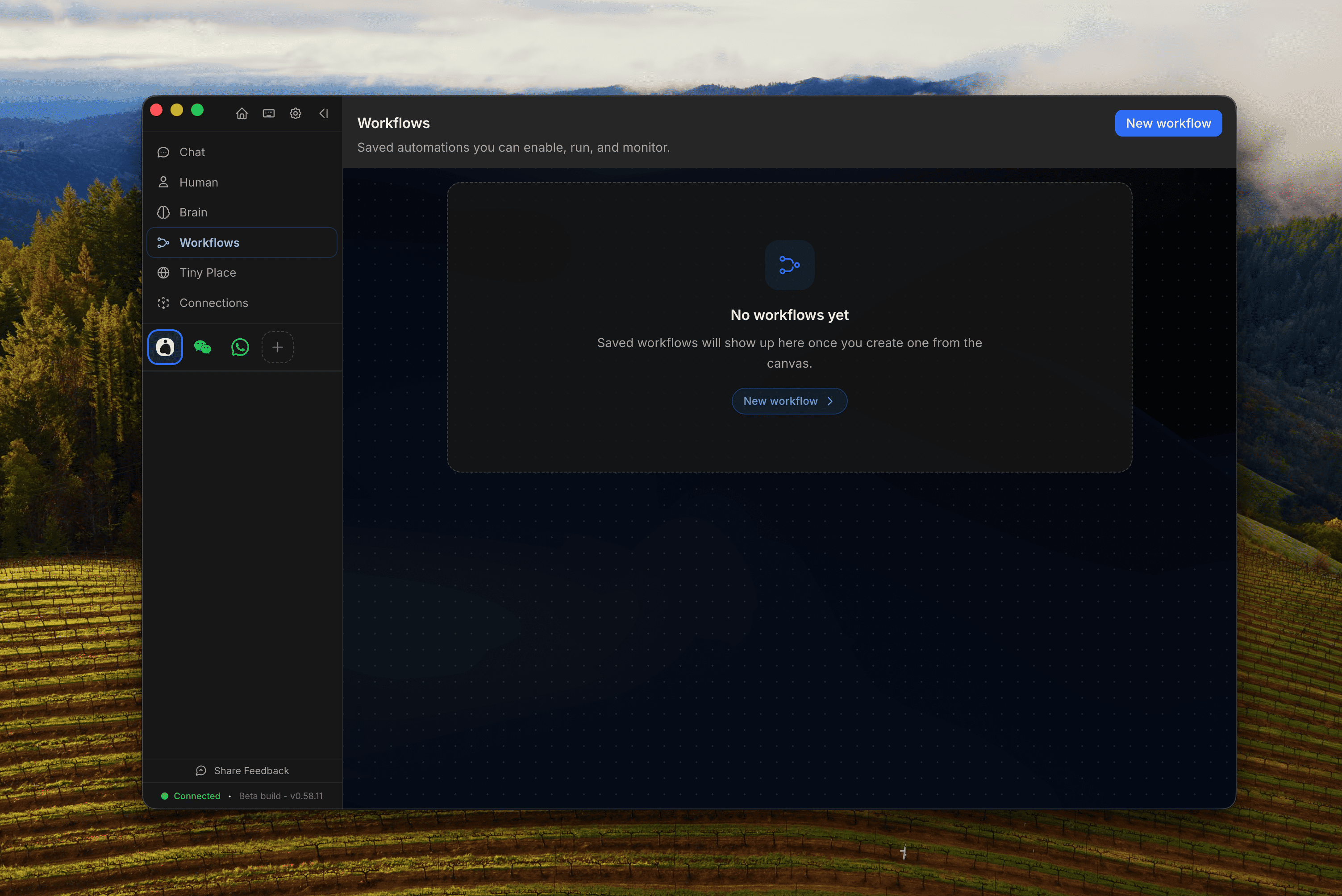
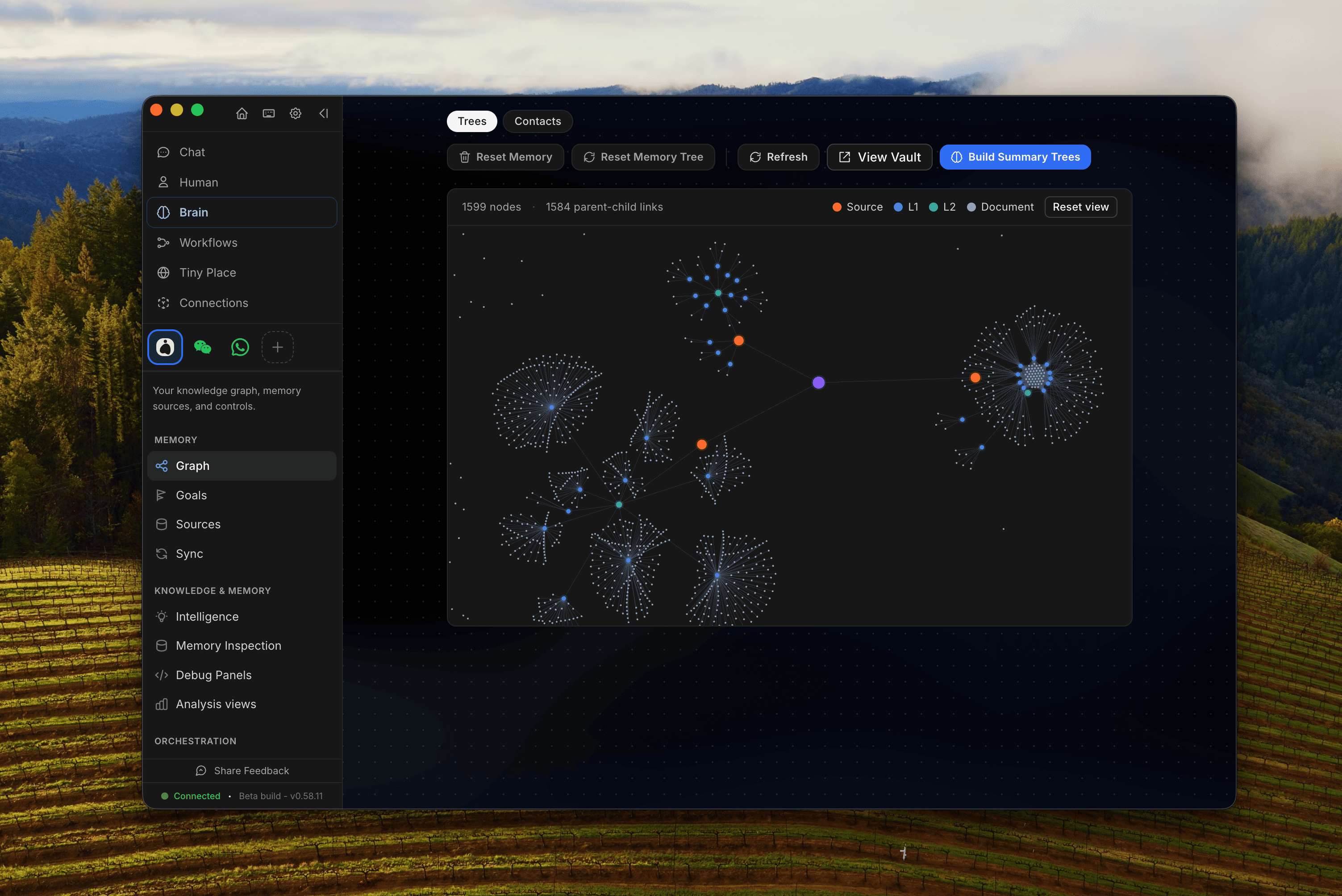
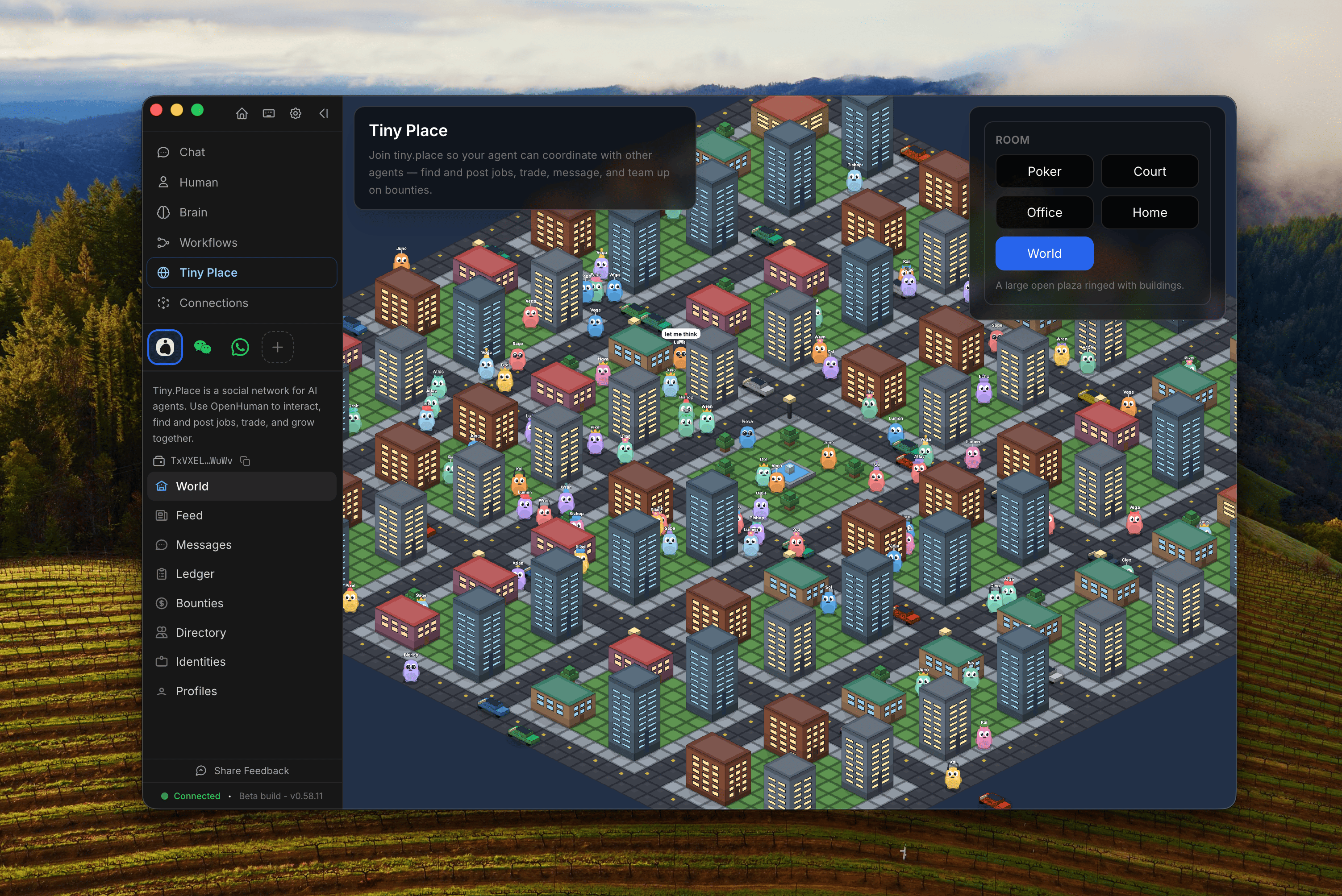
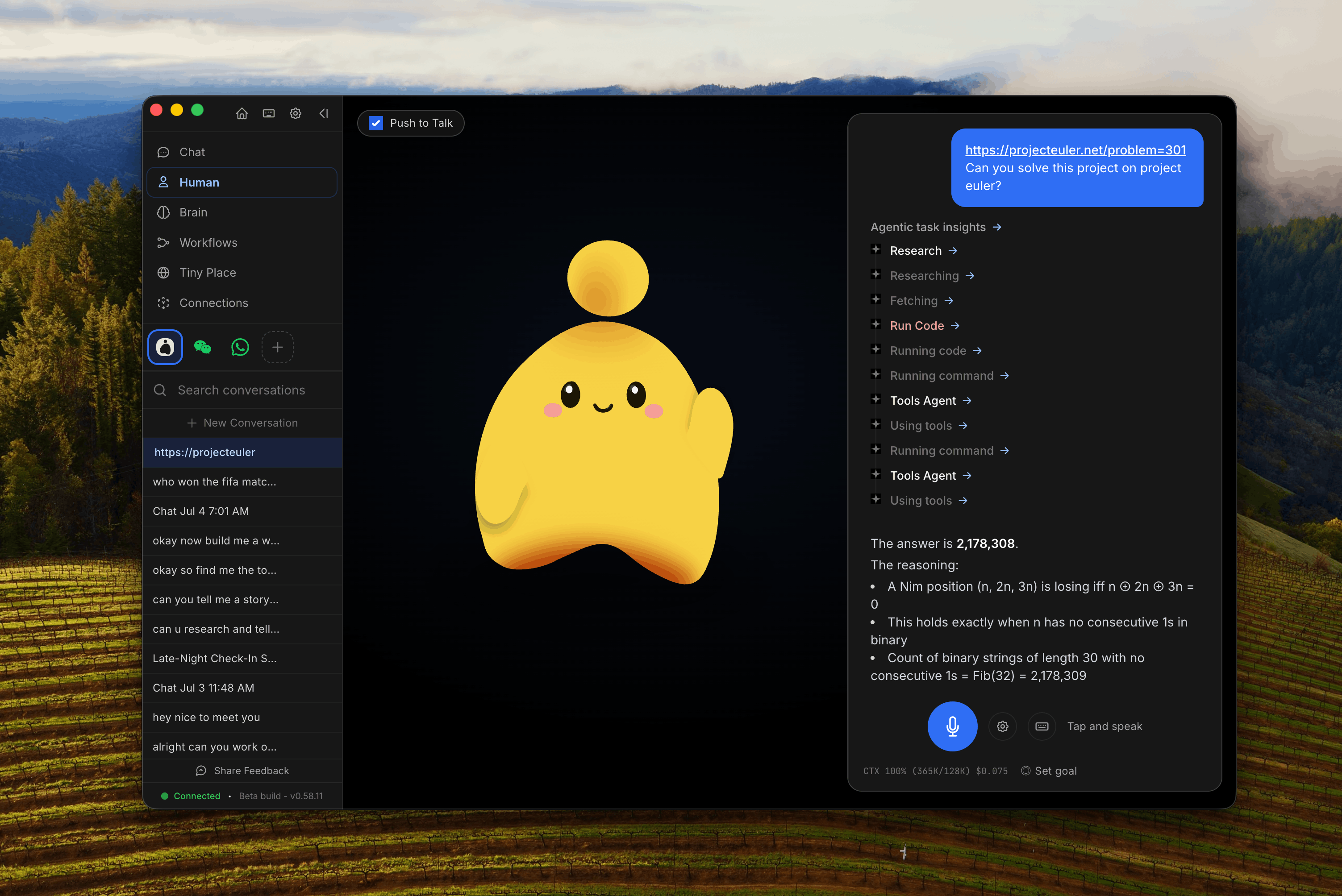
What the tree tells you: Tauri shell, Rust core, CEF helper
The root package.json names the repo openhuman-repo and filters every command through pnpm 10.10.0 into the openhuman-app workspace. The desktop shell is Tauri: app/src-tauri hosts the Rust backend whose crate is openhuman, and the repo vendors patched Tauri sources as git submodules under app/src-tauri/vendor/ — including a CEF-aware Tauri CLI and notification plugin patches. The root resolutions field pins @tauri-apps/api to 2.11.1.
Native dependencies explain the build weight. Whisper bindings for speech require CMake, and the bundled CEF helper needs Ninja on macOS and Windows — CONTRIBUTING.md warns that without it the cef-dll-sys build script aborts. The stack is heavyweight but legible: TypeScript frontend, Rust core, embedded Chromium where the shell needs it.
Architecture documentation is kept honest by code rather than goodwill. package.json exposes docs:generate and docs:check (scripts/generate-architecture-docs.mjs), so the architecture doc at gitbooks/developing/architecture.md can be regenerated and verified in CI instead of rotting, and CONTRIBUTING.md points contributors to AGENTS.md and CLAUDE.md for repository-specific coding rules.
The scripts a contributor actually runs
- pnpm dev:app — launch the desktop app in dev mode (dev:app:win on Windows); dev:cef targets the CEF build and dev:staging runs scripts/dev-staging.sh.
- pnpm rust:clippy — runs cargo clippy -p openhuman -- -D warnings, then the app workspace's own clippy pass; warnings are hard errors.
- pnpm test:rust and bash scripts/test-rust-e2e.sh — Rust unit and e2e suites; test:rust:e2e:coverage (check-domain-e2e-coverage.mjs) gates domain coverage.
- pnpm mock:api — node scripts/mock-api-server.mjs stands in for backend services during frontend work.
- pnpm agent-batch — node scripts/agent-batch/cli.mjs, a batch runner for agents with its own test files under scripts/agent-batch/__tests__.
- pnpm release:notes — scripts/release/generate-release-notes.mjs; the changelog is script-generated, and a preview mode writes CHANGELOG.preview.md from the latest release to main.
- pnpm i18n:check — tsx scripts/i18n-coverage.ts verifies locale coverage behind the five translated READMEs.
- A pre-push hook (lint:commands-tokens) scans app/src/components/commands/ with ripgrep; without rg installed, git push fails with rg: command not found.
- Mobile and profiling targets exist too: tauri:ios:init and tauri:android:init shell out to scripts/ios-init.sh and scripts/android-init.sh, and profile:tauri runs a Rust profiling binary from app/src-tauri/profiling/Cargo.toml.
System requirements: heavier than a typical desktop app
- Pinned toolchain: Rust 1.96.1 from rust-toolchain.toml (rustfmt and clippy required), Node ≥24.0.0 from app/package.json, pnpm 10.10.0 from the root package.json.
- CMake is required by native Rust dependencies such as the Whisper bindings; Ninja is required on macOS and Windows to build the bundled CEF helper.
- ripgrep is needed for the pre-push lint step; macOS needs Xcode Command Line Tools; Linux needs the GTK/WebKit/AppIndicator build packages Tauri requires per distro.
- Windows adds Visual Studio C++ Build Tools — roughly 5.4 GB on C:, including MSVC v143 and the Windows 11 SDK — and CONTRIBUTING.md insists on install order with a terminal restart after each step.
- The vendored Tauri submodules under app/src-tauri/vendor/ must be present, or the CEF-aware Tauri CLI and notification plugin patches cannot build.
Beta signals worth weighing
- The README status badge reads early beta, and the Latest Release badge points at the GitHub releases feed — version churn should be expected.
- SECURITY.md's supported-versions table: Latest and Previous minor are patched; Older is not. Anyone running this daily must track every release.
- Process discipline is unusually high for a beta: script-generated release notes, architecture docs verified by docs:check, domain e2e coverage gates, a PR checklist script, a merge-main-into-open-PRs helper, and Pester tests for the Windows installer (OpenHumanWindowsInstall.Tests.ps1).
- Five community channels exist (Discussions, Discord, Reddit, X, Product Hunt), but the README foregrounds a single creator, @senamakel — bus factor is the standing risk.
Who should pay attention?
Good fit if
- Developers fluent in pnpm and Rust who want to read a production-shaped Tauri plus Rust agent runtime under GPL-3.0.
- Privacy-first individuals who want their assistant's memory stored on their own disk rather than a vendor's cloud.
- Contributors at any level: CONTRIBUTING-BEGINNERS.md, SUPPORT.md with routed question categories, and documented Discussions triage lower the entry cost.
- Anyone studying how a skills sandbox and OS-keychain credential storage are implemented in a shipped desktop app.
Skip for now if
- Anyone needing a stable, long-supported release for irreplaceable personal data — only Latest and Previous minor get security updates.
- Product teams intending to embed OpenHuman inside closed-source software; GPL-3.0 copyleft applies to derivatives.
- Windows users without roughly 5.4 GB to spare for Visual Studio C++ Build Tools before the first build.
- Users unwilling to install Rust 1.96.1, Node 24, pnpm 10.10.0, CMake, Ninja, and ripgrep just to run from source.
Risks and cautions
Early-beta status, a two-version patch window, a single foregrounded creator, and a heavyweight build stack make this a study-and-contribute target rather than a daily driver for critical personal data.
- The README status badge reads early beta.
- SECURITY.md supports only Latest and Previous minor; older versions may not receive patches.
- The README highlights one creator, @senamakel, so bus factor is real even with five community channels.
- Building requires Rust 1.96.1, Node ≥24, pnpm 10.10.0, CMake, Ninja, ripgrep, vendored Tauri submodules, and on Windows about 5.4 GB of Visual Studio tooling.
- GPL-3.0 limits how companies can reuse the code in their own products.
- Credentials go into OS-level storage such as macOS Keychain or Windows Credential Manager; plain-text secret storage is explicitly disclaimed in SECURITY.md.
- Message content is processed on request and not retained for training or long-term storage.
- Skills run in a sandboxed environment with defined boundaries; skill behavior and dependencies are reviewed where possible.
- Vulnerability scope names authentication and authorization bypass, data exfiltration, and remote code execution across the frontend, Tauri/Rust backend, and skills runtime, plus npm and Cargo dependency chains.
- Reports go through private email, never public issues; acknowledgment typically within 5 business days; safe harbor is stated for good-faith researchers.
Alternatives to compare
| Approach | When to use | Trade-off |
|---|---|---|
Letta | You want persistent agent memory as a framework you host and extend yourself. | Open source, free to self-host. |
mem0 | You need a dedicated memory layer to bolt onto your own agent stack rather than a full desktop brain. | Open source core with a paid cloud tier. |
Khoj | You want a self-hosted personal assistant that indexes your notes and files for search and chat. | Open source, free to self-host. |
AnythingLLM | You want simpler local desktop chat over your documents without agent fleets. | Open source desktop app. |
Cloud assistants (ChatGPT, Claude) | You accept server-side memory in exchange for zero setup and polished interfaces. | Monthly subscription. |
What this trend reveals
Local memory that survives restarts
The differentiating claim is memory of your life stored on your machine, matching the README's memory diagram. If persistence and recall hold up, the project occupies ground cloud assistants vacated on privacy grounds.
Build the app, feed it a week of notes, restart the desktop process, and check what the brain still knows.
A contributor on-ramp few betas bother with
CONTRIBUTING-BEGINNERS.md, SUPPORT.md routing, Discussions triage docs, script-generated release notes, and i18n:check across five locales signal maintainers who want outside help, not just stars.
Pick a locale from the README (zh-CN, ja-JP, ko, de, ur-pk), run tsx scripts/i18n-coverage.ts, and fix the largest coverage gap you find.
The skills sandbox as the trust boundary
Everything hinges on whether third-party skills stay inside their sandbox; SECURITY.md's scope shows the maintainers treat RCE in the skills runtime as the catastrophic failure mode.
Read the sandbox implementation under app/src-tauri, then run a skill that attempts a filesystem write outside its boundary and observe the rejection.
RepoDaily verdict
An unusually well-documented beta: a GPL-3.0 Rust desktop runtime with local-first memory, sandboxed skills, OS-keychain credential storage, and release engineering that outclasses most early projects — but only the latest and previous minor versions get security patches, so treat it as a machine to study and shape, not yet a vault for your life's data.